
For exterior timber, applying CUTEK® Extreme CD50 as a clear oil will protect the wood against moisture while allowing it to naturally lighten/silver to a natural patina over time as long as it is exposed to the sun.
Knots
When CUTEK® Extreme CD50 is applied it diffuses deeply into the wood and displaces moisture. This reduction in moisture content may loosen some knots, particularly in very knotty woods.
Moisture in Wood
Wood is divided, according to its botanical origin, into two kinds: Softwoods from coniferous trees and hardwoods from broadleaved trees. Structurally softwoods are generally simple in structure and lighter whereas hardwoods are generally complex in structure and harder. Softwood (like pine wood) is much lighter and easier to process than the heavy hardwood (like fruit tree wood). The density of softwoods generally ranges between 350-700 kg/m³, while hardwoods are 450-1250 kg/m³. Both consist of approximately 12 % moisture. Due to the more dense and complex structure of hardwood, the permeability is very low in comparison to softwood, thus making it more difficult to dry. The timber of living trees and freshly felled logs contains a large amount of water, which often constitutes more weight than the actual wood. Water has a significant influence on wood. Wood continually exchanges liquid and gas phase moisture (water) with its surroundings, although the rate of exchange is strongly affected by the degree wood is sealed. Dried timbers that are coated with deeply penetrating hydrophobic (water resisting) CUTEK® Extreme CD50 demonstrate a dramatically slowed rate of moisture exchange.
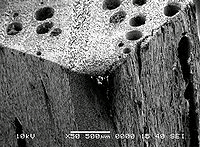
Hardwood
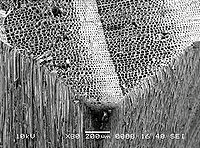
Softwood
Why Do We Dry Timber?
Drying, if carried out promptly after the felling of trees, protects timber against primary decay, fungal stain and attack by certain kinds of insects. Organisms, which cause decay and stain, generally cannot thrive in timber with a moisture content below 20%. Several, though not all, insect pests can live only in green timber. Dried wood is less susceptible to decay than green wood (above 20% moisture content). Apart from the above important advantages of drying timber, the following points are also significant:
- Dried timber is lighter, and hence the transportation and handling costs are reduced.
- Dried timber is stronger than green timber in most strength properties.
- Timbers for impregnation with preservatives have to be properly dried if proper penetration is to be accomplished, particularly in the case of oil-type preservatives.
- In the field of chemical modification of wood and wood products, the material should be dried to a certain moisture content for the appropriate reactions to occur.
- Dry wood works, machines, finishes and glues better than green timber. Paints and finishes last longer on dry timber.
- The electrical and thermal insulation properties of wood are improved by drying.
Fibre Saturation Point
Fibre saturation point is a term used in wood mechanics and especially wood drying, to denote the point in the drying process at which only water bound in the cell walls remains – all other water, called free water, having been removed from the cell cavities. Further drying of the wood results in strengthening of the wood fibres, and is usually accompanied by shrinkage. Wood is normally dried to a point where it is in equilibrium with the atmospheric moisture content or relative humidity, and since this varies so does the equilibrium moisture content.
Equilibrium Moisture Content
Wood is a hygroscopic substance. It has the ability to take in or give off moisture in the form of vapour. The water contained in wood exerts a vapour pressure of its own, which is determined by the maximum size of the capillaries filled with water at any time. If the water vapour pressure in the ambient space is lower than the vapour pressure within wood, desorption takes place. The largest sized capillaries, which are full of water at the time, empty first. The vapour pressure within the wood falls as water is successively contained in smaller and smaller sized capillaries. A stage is eventually reached when the vapour pressure within the wood equals the vapour pressure in the ambient space above the wood, and further desorption ceases. The amount of moisture that remains in the wood at this stage is in equilibrium with the water vapour pressure in the ambient space, and is termed the equilibrium moisture content or EMC.. Because of its hygroscopicity, wood tends to reach a moisture content that is in equilibrium with the relative humidity and temperature of the surrounding air. The EMC of wood varies with the ambient relative humidity to a lesser degree with the temperature. EMC also varies very slightly with species, mechanical stress, drying history of wood, density, extractives content and the direction of sorption in which the moisture change takes place (i.e. adsorption or desorption).
Moisture Content Of Wood In Service
Wood retains its hygroscopic characteristics after it is put into use. It is then subjected to fluctuating humidity, the dominant factor in determining its EMC. These fluctuations may be more or less cyclical, such as diurnal changes or annual seasonal changes. In order to minimise the changes in wood moisture content or the movement of wooden objects in service, wood is usually dried to a moisture content that is close to the average EMC conditions to which it will be exposed. These conditions vary for interior uses compared with exterior uses in a given geographic location.
In New Zealand, the climate varies from one region to another, and as such, EMC can differ depending on the location and season. In New Zealand’s Costal regions due to high relative humidity (RH), the EMC can be relatively high, often in the range of 12% to 16%. Coastal regions such as Northland, Auckland, and the West Coast of the South Island may exhibit these characteristics. Inland and Alpine areas such as Central Otago or Canterbury Plains which can have cold and dry winters might experience lower EMC values, possibly around 8% to 12%. Rainforest regions like the West Coast of the South Island, which is largely rainforest, might have higher EMC values due to the consistent high humidity. New Zealand’s summer, especially in the northern parts, can be humid. During this season, the EMC can be on the higher side. Conversely, during the cold, dry winter months, especially in the South Island, the EMC can be considerably lower.
However, the EMC may be as low as 6 to 7% in dry centrally heated houses and offices or in permanently air-conditioned buildings. The primary reason for drying wood to a moisture content equivalent to its mean EMC under use conditions is to minimise the dimensional changes (or movement) in the final product. Dried timbers that are coated with CUTEK® Extreme CD50 are less susceptible to dimensional changes because the deeply penetrating hydrophobic (water resisting) nature of CUTEK® Extreme CD50 minimises the free absorption and desorption of liquid and gas phase moisture.
Plywood
Applying CUTEK® Extreme CD50 to some decorative plywoods with extremely thin top veneers may cause underlying dark veneer glue lines to become visible due to the penetration of the CUTEK® oil rendering the top veneer semi-transparent. For this reason, we do not recommend the use of CUTEK® Extreme CD50 for plywood.
Rubber & Butynol
CUTEK® Extreme CD50 will dissolve rubber-based glues and adhesives, and will affect Butynol and rubber surfaces if not wiped off soon after contact is made. It also may affect some silicones in a similar fashion.
When CUTEK® Extreme CD50 are applied to wooden shingles, they do not normally affect the Butynol underlay. Wood protected with CUTEK® exerior timber oils can become stained if it is in constant contact with bituminous type materials. Order a on our website or from your nearest reseller to make sure CUTEK® oils are right for your project.
Should I only use CUTEK® Quickclean to prepare my timber for a maintenance coat of CUTEK® Exterior timber oils?
We believe CUTEK® Quickclean is the premier timber cleaner in the market. CUTEK® Quickclean is perfect to clean your timber in preparation for a maintenance coat of CUTEK® Extreme CD50, however it can also be used for regular timber cleaning.
Regular timber cleaning is important to maximising service life of wood and with CUTEK® Quickclean, timber cleaning is easy and cost effective.
Shrinkage and Movement
Shrinkage and swelling may occur in wood when the moisture content of timber is changed. Shrinkage occurs as moisture content decreases, while swelling takes place when it increases. Volume change is not equal in all directions. The greatest dimensional change occurs in a direction tangential to the growth rings. Shrinkage from the pith outwards, or radially, is usually considerably less than tangential shrinkage, while longitudinal (along the grain) shrinkage is so slight as to be usually neglected. The longitudinal shrinkage is 0.1 to 0.3%, in contrast to transverse shrinkages, which is 2-10%. Tangential shrinkage is often about twice as great as in the radial direction, although in some species it may be as much as five times as great. The shrinkage is species dependent and can be typically 5 to 10% in the tangential direction and 2 to 6% in the radial direction. Dried timbers that are coated with CUTEK® Extreme CD50 are less susceptible to dimensional changes because the deeply penetrating hydrophobic (water resisting) nature of CUTEK® Extreme CD50 minimises the free absorption and desorption of liquid and gas phase moisture therefore assisting with maintaining the dimensional integrity of moisture stabilised timbers.
Factors Affecting the Dried Appearance, and Dimensional Integrity of Wood
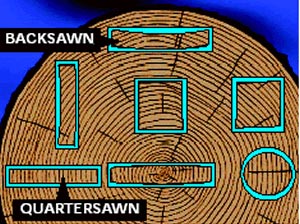 Factors that significantly affect the drying, appearance and dimensional integrity of dried timbers are:
- The species; because of the variations in physical, mechanical and moisture transport properties between species.
- The thickness of the timber; because the drying time is approximately proportional to thickness and, to some extent, is also influenced by the width of the timber.
- Whether the timber boards are quarter-sawn, back-sawn or mixed-sawn; because sawing pattern influences the distortion due to tangential and radial shrinkage. This leads to warping, cupping, bowing, twisting, spring and diamonding. (see image)
- Defects that arise due to uneven drying such as rupture of the wood tissue, checks (surface, end and internal), end splits, honey-combing, case hardening and collapse.
Stains and Leaching
Stains On Wood Due to Natural Causes
Wood is a natural material that contains a wide variety of compounds that are termed “extractives”. While they are not part of the essential wood structure, they contribute to natural colour, odour, durability and moisture absorbency of a particular species, and may comprise of polyphenols, terpenes, oils, fats, gums, resins and waxes.
Extractives can leach to the surface of the wood and stain the wood.
Stains On Processed Wood Arising from Damage To The Living Tree
If the protective bark on a tree is ruptured the tree will respond by forming protective compounds. Any ruptures potentially expose the tree to invasion by a variety of organisms. If these compounds and organisms are exposed to oxygen and weather it may cause an unsightly stain on processed wood.
Stains Due to Chemical Changes In Wood Extractives
As wood grows streaks or blotches of different shades can occur. It’s these variations that add character to the wood and enhance its decorative value. However, when processed wood is placed in the environment and exposed to oxygen and light these natural colour variations can significantly change. Often blonde woods acquire a yellowish tint and red woods become browner.
Stains And Leaching Due to Water
If processed wood is exposed to moisture in the environment some of the extractive may leach to the surface, and dissolve, creating watermarks. If the extractive runoff the surface of the wood they can actually stain surrounding surfaces like concrete, tiles and pavers.
Tannins (polyphenols) in particular are likely to react with alkaline surfaces such as concrete to form an unsightly red/brown stain.
In New Zealand, Macrocarpa, Totara, and imported timbers such as Merbau and Vitex are particularly prone to causing such staining. If left alone to weather, the level of extractive runoff will reduce and result in a significant reduction in ongoing staining over time. Chemical cleaning and removal of these stains is a simple and easy process with CUTEK® Restore.
Stains Caused by Chemical Reaction with Iron
Many wood species have a high tannin content. If the wood gets wet the tannins can react with iron to form black and insoluble iron stain.
This can cause dark discolouration’s that can appear suddenly. These stains are often caused as a result of contact with a steel blade or tool during processing or fixing. The stains are limited to the surface and can be cleaned and removed easily.
In New Zealand we have noticed timbers like Macrocarpa and Western Red Cedar are particularly susceptible to this issue. More information on iron stain is available in the tab labelled Iron Stain.
Pre-Cleaning Susceptible Woods
If you’re using wood with a high level of extractives and fixing it in a wet environment, we recommend a pre-clean using CUTEK® Restore prior to coating with CUTEK® Extreme CD50.
While we can’t offer a 100% guarantee due to the varied nature of wood, in our experience a pre-clean helps reduce the chance of stains and helps minimise any stains that do occur.
Removing Stains and Leachate
Easily remove iron tannates on wood and leachates on adjacent surfaces with CUTEK® Restore. Follow the procedures in the CUTEK® Restore factsheet for the best result.
Surface Contamination
It is very important to ensure that timber surfaces to be coated with CUTEK® oils are free from chemical residues and are not exposed to environmental contaminants such as dusts while the applied CUTEK is drying. It is possible that contact with highly alkaline contaminants such as cement/fertiliser/other dusts or poorly rinsed cleaners may lead to chemical staining.
Using CUTEK® exterior timber oils on Bamboo
As a substitute for hardwood floors bamboo can be an attractive choice. It looks great and as a renewable resource is an environmentally friendly option. Engineered bamboo offers stability and good looks too.
However, bamboo isn’t wood and behaves very differently. It needs a much higher level of care and a different approach to make sure it’s protected and stays looking its best for as long as possible.
We recommend using CUTEK® Extreme CD50 on bamboo. Other CUTEK® oils are not suitable for bamboo.
Bamboo is a grass, and doesn’t contain the extractives that give durability to many woods. It’s also very hygroscopic, meaning it takes up moisture rapidly and can also dry out very quickly, especially in direct sun. This makes engineered bamboo very susceptible to unsightly black staining moulds and significant surface erosion when exposed to rain and sun meaning that it will split/check and go grey/black rapidly if not properly protected.
Additionally, because engineered bamboo absorbs and releases moisture very quickly, most traditional wood coatings, deck stains and oils don’t last very long on fully weather exposed material.
We have observed that what may work reasonably well on wood for 6 to 12 months can often fail on bamboo material inside 12 weeks from time of application.
In our many years of testing, observation and user feedback, we have found that some engineered bamboo products are just not suitable for full weather exposed applications, despite manufacturer’s claims.
If you’re using CUTEK ® Extreme CD50 on bamboo we recommend following this process for best results.
It’s important to be aware that there are many engineered bamboo products on the market, of widely varying quality. CUTEK® Extreme CD50 may or may not work on your chosen engineered bamboo product despite following our recommendations.
- Inspect your bamboo surface on a regular basis after coating and clean with CUTEK® Restore or CUTEK® QuickClean at the first sign of mould or surface erosion/splitting, followed by a reapplication of a thin coat of CUTEK® Extreme CD50. This must be done as frequently as is necessary.
- If installing a bamboo deck that has been factory precoated with CUTEK® Extreme CD50 it will need at least one thin coat within one month of install. If mixing in a CUTEK® Colourtone to alter the existing colour, then two coats will be needed for adequate colour build. A further coat should be applied within 6 months, and another after 12 months.
New bamboo decking which has not been precoated with CUTEK® Extreme CD50 should be coated on all sides before installation, and given two further coats with a CUTEK® Colourtone within a month of installation, following the application procedure on the label.
A further coat should be applied within 6 months, and another after 12 months.
- If using strand woven bamboo this product can contain glue which varies in quality. CUTEK® Extreme CD50 will not penetrate the glue in strand woven bamboo as it forms a physical barrier. Some products are very prone to surface expansion and become very rough. If this occurs, sanding back to a flat surface using 80 grit paper is the best preparation prior to application of CUTEK® Extreme CD50.
Clear CUTEK® Extreme CD50 can be used without a CUTEK® Colourtone, and will fade to a very light natural matt colour over a couple of months, but will resist greying for some time before needing to be recoated. To maintain a ‘freshly oiled’ look, more frequent oiling is required.
IMPORTANT NOTE
While the procedures detailed above have proven in some cases to produce a satisfactory result in the decorative coating of engineered bamboo in many countries and are detailed in good faith to assist people, we do not, and are unable to, offer any warranty or performance guarantee of any type (including but not limited to any warranty or performance guarantee in respect of coating longevity, mould/fungi degradation, and splitting/delamination) for the use of any CUTEK® products on any bamboo substrate.
This is due to the wide variation in the quality of products in the engineered bamboo market including variations in manufacturing processes, varying quality control, varying efficacy of preservative/treatment processes, origin of the raw bamboo, time of bamboo harvest, quality of the glues, place of manufacture etc.
Some manufacturers choose to specify CUTEK® oils as suitable for their engineered bamboo product, but this does not mean that we are included or involved in any independent warranties issued or implied by a specific manufacturer or distributor in relation to their product.